
Butchery & Meat
Processing
POS Solutions.
From scale to sale in one transaction. Purpose-built POS for butcheries that need precision weight capture, cut tracking, and waste control, backed by 25 years of South African retail expertise.
What Is the Best POS System for a
Butcher Shop with Inventory Tracking?
The best POS system for a butcher shop with inventory tracking is one that measures yield at the point of cut, not just money at the till. Shrinkage is the reason. Average retail shrink on fresh meat, poultry and seafood reached 12,7% in 2011–12, almost three times the 4,5% recorded in 2005–06, according to the USDA Economic Research Service, with individual lines running as high as 24,1%. A till that records only what was scanned cannot see that loss. It balances perfectly at close of trade while a tenth of your stock has left as trim, spoilage, or a generous hand on the scale.
The unit of sale in a butchery is a weight, not an item, and that is where most retail POS systems stop being useful. A carcass comes in at one mass and leaves as dozens of priced lines at different yields. Unless the scale and the till are the same system, the difference between what you bought and what you sold is a monthly guess. Ask what happens to the 200g of trim: a system that tracks inventory properly books it against the primal it came from, so the yield on that cut is visible while you can still do something about it.
Cold chain is the second place stock disappears, and in South Africa that is not theoretical. Businesses surveyed by the Global Cold Chain Alliance reported load-shedding revenue losses concentrated in the R50 000 to R500 000 band, while the monthly cost of simply holding temperature ran from under R50 000 to over R1 million. One major South African retailer's outage costs "skyrocketed over R500 million just to run generators", a figure that excludes the stock lost anyway, according to BDO South Africa. A POS that stops trading when the power does adds a lost till to a lost fridge.
Then there is the paperwork you are legally required to produce. Under the Meat Safety Act, 2000 (Act 40 of 2000), traceability means being able to show "what exactly was received from whom, and what exactly was sent to whom". A butchery has to document the origin of meat and the time of delivery. If that lives in a delivery book behind the counter, a recall becomes an afternoon of paging through handwriting. If receiving runs through the POS, it is a query.
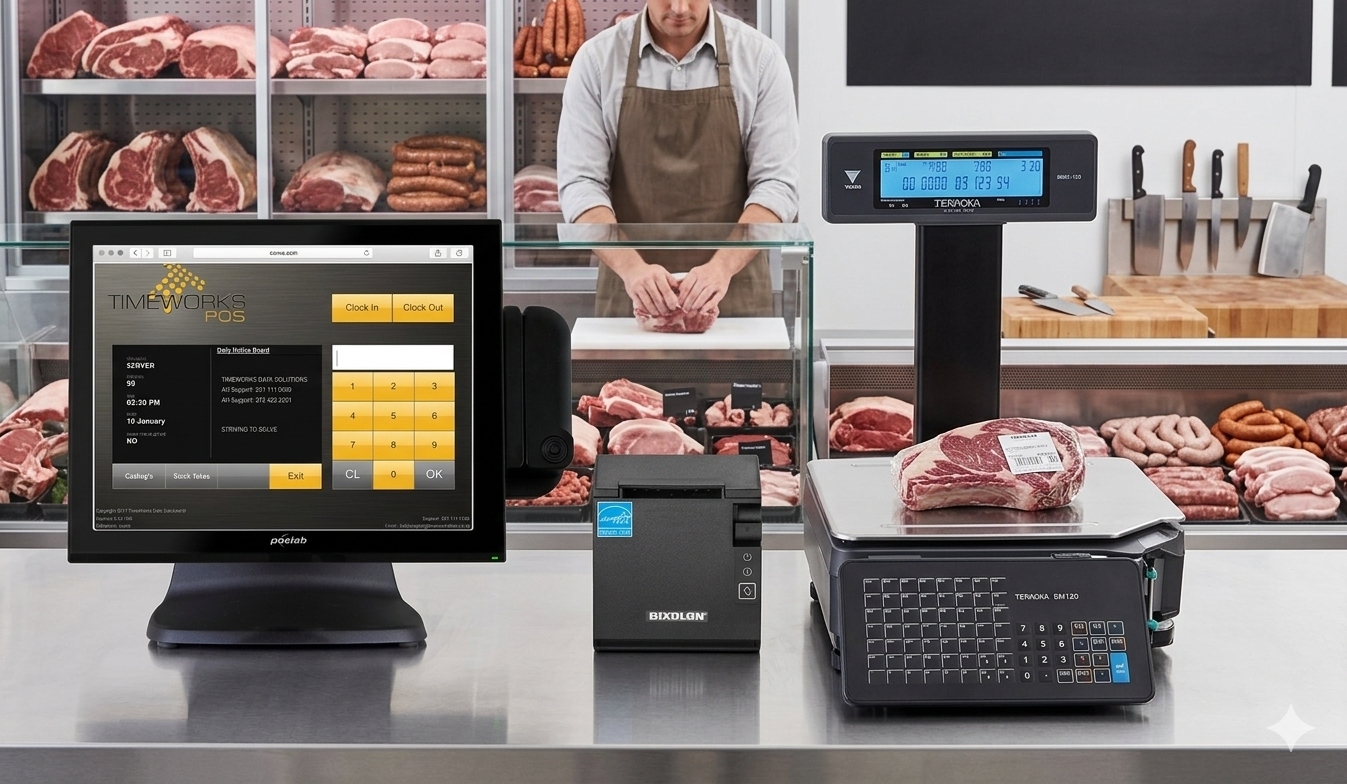
That is why TimeWorks runs on a local Microsoft SQL database inside your shop rather than in a browser tab, reads your scales directly, and keeps receiving, yield and sales in one ledger. The counter keeps trading when the line drops, and the stock figures still reconcile afterwards.
| What a butchery demands | Why it matters | What to check before you buy |
|---|---|---|
| Yield and shrinkage visibility | Retail shrink on fresh meat averaged 12,7%, up from 4,5% six years earlier (USDA ERS). | Can you see yield per primal, not just gross profit per department, and see it this week rather than at stocktake? |
| Scale integration | Weight is the unit of sale. Re-keying a mass is where pricing errors and untracked trim enter the books. | Does the till read the scale directly and print the priced barcode label, or does someone type the number in? |
| Trading through an outage | Load-shedding revenue losses clustered at R50 000 to R500 000 per business (GCCA). | Does the counter keep selling with no internet, and does it sync by itself when the line returns? |
| Traceability records | The Meat Safety Act requires you to show what was received from whom, and sent to whom (Agribook). | Is goods-received captured in the same system as sales, so a recall is a search rather than a shoebox? |
| More than one counter | Retail, pre-pack and wholesale price the same product differently and draw on the same cold room. | Can one stock pool serve several counters and price lists without double-capturing the receipt? |
Built for the Counter,
Not Retrofitted.
Every feature designed around how a real butchery operates, from carcass intake to customer sale.
Scale Integration
Direct interface with trade-approved scales from Digi, Mettler Toledo, and CAS. Weight captures automatically into the transaction, with zero manual entry and zero pricing errors.
Cut & Product Tracking
Track individual cuts, offcuts, and mince batches against their source primal or carcass. Record trim waste by cut type (rump, sirloin, brisket) so you know exactly what came in, what sold, and what was lost at every station.
Waste Management
Capture trim losses and processing yields against each carcass in real time. Shrinkage reports break down waste by cut type and staff member, so you can identify whether the problem is a specific cut, a process, or a shift, and act before it compounds into serious margin loss.
Cold Chain Compliance
Temperature monitoring integration keeps your cold storage records audit-ready. Expiry date tracking on every product ensures full regulatory compliance at all times.
Multi-Counter Operations
Serve counter, pre-pack line, and wholesale desk all on one SQL database. Each counter has its own scale and printer, and managers get one unified performance view.
Barcode & Label Printing
Print GS1-compliant weight-embedded barcodes directly from the POS or a dedicated label printer. Each label shows product name, cut description, weight, price per kg, total sell price, and expiry date: everything a customer or inspector needs on a single label, printed in under 3 seconds.
25 years cutting
no corners.
We have been in South African food retail longer than most butchery software vendors have existed. Our Microsoft SQL backbone means your data is always there, even if the network drops mid-trade.
Speak to a SpecialistYears in SA Food Retail
Serving butcheries, delis, and food retailers across South Africa since 1999. We understand local compliance, local suppliers, and local trading hours.
Microsoft SQL Backend
Enterprise-grade data integrity. Transactions never silently fail, weight records never corrupt, and your audit trail is always complete, even under peak Saturday load.
Rental from R995/month
Full POS terminal with scale integration from R995 per month excluding VAT. Daily or weekly rental is on request: contact us for pricing. Ideal for pop-up markets, seasonal peaks, or trialling before you commit.
Support Including Weekends
Butcheries trade Saturday mornings and public holidays. So do we. Our support team is reachable when you actually need them, not just during office hours.
Common Questions
Answers to the questions butchery owners ask most when evaluating a new POS system.
Ready to Upgrade
Your Butchery?
Talk to a TimeWorks specialist who knows butchery operations. Get a system configured for your counters, your scales, and your margins.