
Pet Shop POS System
for Inventory Control.
A POS for a pet shop with inventory control needs takes every bag of food, treat, toy and flea treatment off stock the moment it is sold, warns you before a line runs out, and bills grooming services on the same till. A TimeWorks pet shop POS system does this on a local SQL database with a Zebra barcode scanner, with rental from R995 per month excluding VAT covering hardware, software and support.
POS for a Pet Shop
with Inventory Control Needs
A POS for a pet shop with inventory control needs does four jobs at the counter: it scans the barcode on every bag, tin and box so each pack size sells and counts as its own product, it takes the sale off stock the moment it is rung up, it warns you when a food or health line drops to its reorder level, and it bills grooming services on the same till as the food and accessories. Get those right and the shelf, the till and the reorder report agree. Miss one and you find out about a stockout when a regular customer asks for their dog's food and it is not there.
Here is how that works on a TimeWorks pet shop POS system. Products are organised by species (dogs, cats, birds, fish, reptiles and small animals) and then by food, health products, accessories and grooming supplies, so the cashier finds the right item fast and your reports show which species and category earn the most. The cashier scans the item with a Zebra LI2208 handheld scanner, which reads EAN-13, Code 128 and UPC-A and drops into its Intelli Stand for hands-free scanning. Each product has its own minimum reorder level, and the low-stock report turns into a supplier purchase order, so the bag of food your regulars buy every month is reordered before it runs out.
Pet stock is harder to manage than most retail. AMS Retail's guide to pet store inventory lists what a pet shop carries: food and treats with strict expiration dates, temperature-sensitive supplements and medications, seasonal flea, tick and parasite products, accessories and prescription diets. It also notes that when a pet owner's specific prescription diet or formula is out of stock, they turn to a competitor or order online. A stock count that the till updates with every sale is how you see that gap before the customer does.
South African pet food comes with its own label rules. The Pet Food Industry Association of Southern Africa explains that a pet food's registration or "V number" shows the product is legally registered and meets the minimum nutritional standards set out by Act 36, and that the batch number or manufacturing date is the traceable link if a recall is needed. The best before date also shows how old the product is. Give each bag size and flavour its own product and barcode, and the POS tells you exactly which lines you hold and how fast each one sells, so slow lines do not sit on the shelf until their best before date.
Health products need two kinds of handling. A stock remedy, used to prevent or treat unhealthy conditions in domestic animals, livestock, poultry, fish or wild animals, must be registered with the Registrar of Act 36 of 1947 before it is imported, made or sold in South Africa. A 2011 South African Medical Journal article explains the split for animal antibiotics: those registered under Act 36 as stock remedies are sold over the counter, while those registered under the Medicines and Related Substances Control Act 101 of 1965 may only be administered or prescribed by a veterinarian. Check which of the two each health product on your shelf is registered under before you stock it.
Not everything arrives with a barcode. Repacked treats, own-brand lines and anything sold loose need one, so print your own Code 128 or EAN-13 labels on a Zebra or TSC shelf and barcode label printer, which reprints a label in one click from TimeWorks. If you sell bird seed or loose food by weight, a POS weighing scale from CAS or Mettler-Toledo connects to the till, so the price per kilogram comes from the product record. Keep the shelf price in line with the scan: section 23 of the Consumer Protection Act 68 of 2008 says a customer may not be made to pay more than the displayed price, and if more than one price is displayed, the lowest one applies.
Grooming is part of the same sale. A booked grooming appointment opens at the till with its services already on the bill, extras the groomer adds are priced in, and the groomer's commission is worked out from the rate you set. Loyalty points build on food, accessories and grooming alike, a food subscription discount applies to the brand a regular buys every month, and birthday and adoption-anniversary vouchers bring owners back.
VAT and power are the South African part of the job. SARS levies VAT at the standard rate of 15%, and from 1 April 2026 the compulsory VAT registration threshold rose from R1 million to R2.3 million. On TimeWorks, the VAT on every slip comes from the product record, not the cashier. Eskom ended winter 2025 with 26 hours of load shedding across four evenings, supplying electricity 97% of the time. TimeWorks runs on a local SQL database, so scans, stock lookups and sales carry on when the internet drops and sync when it returns. Offline mode does not supply power, so a UPS battery backup sized to your hardware keeps the till running through an outage.
Finally, cost. POS software is R350 per month excluding VAT for the Cloud-Based Entry POS, for up to two users with basic sales tracking, or R500 per month excluding VAT for the Full Business Solution, which adds advanced stock control, debtors and creditors management and unlimited users. For inventory control, the Full Business Solution is the one to choose. Both are on our POS software plans page. Rent the full setup month to month from R995 per month excluding VAT, with a terminal, printer, software and support included; daily rental is contact for pricing. Comparing Lightspeed for a pet shop? Read our TimeWorks vs Lightspeed comparison.
| What a pet shop till needs | Why it matters in a South African pet shop | How TimeWorks does it |
|---|---|---|
| A barcode per pack | Food comes in many sizes and flavours, each with its own registration number and batch (PFI). | Each pack is its own product, scanned with a Zebra LI2208, R1,595 excluding VAT. |
| Reorder before it runs out | An owner who cannot find their pet's food buys it elsewhere (AMS Retail). | Minimum reorder level per product; purchase orders from the low-stock report. |
| Labels for loose stock | Repacked and loose items arrive with no barcode. | Zebra or TSC label printer, R2,495 to R5,995 excluding VAT. |
| Shelf price = scan price | A customer never pays more than the displayed price (CPA section 23). | One-click label reprints from TimeWorks. |
| Grooming on the same bill | Services and products sold together in one visit. | Appointments open pre-filled at the till; commission per groomer. |
| Trading through outages | A till that needs the internet for every scan stops when the line drops. | Local SQL database; UPS sized to your hardware. |
See every terminal, scanner and printer on our POS hardware page. A pharmacy faces the same scheduled-stock questions: see how a pharmacy POS records scheduled sales. Running a large catalogue of barcoded stock? The hardware store POS shows how one scan handles pack sizes and units.
Stock, Grooming and Loyalty,
Behind Every Sale.
The modules a South African pet shop uses every day, from the food aisle to the grooming room.
Species-Specific Product Organisation
Organise your product catalogue by species, dogs, cats, birds, fish, reptiles, and small animals, with sub-categories for food, health products, accessories, and grooming supplies. Counter staff navigate to the correct species section in seconds, reducing transaction time and the risk of selling a canine flea treatment to a cat owner. Category-level stock reports let you identify which species and product type drive your highest revenue and margin.
Grooming Appointment Billing
Link grooming appointments to billing at checkout so the transaction pre-fills with the booked services, the pet's name and breed, and the assigned groomer. Billing reflects exactly what was done rather than requiring the receptionist to build the invoice from memory. Groomers can flag additional services performed, such as a nail clip added during the session, and the system adds the charge and updates the groomer's commission record.
Barcode Labels and One-Click Reprints
Repacked treats, own-brand lines and loose stock need a barcode before they can be scanned. Print Code 128 or EAN-13 labels on a Zebra or TSC label printer, and reprint any shelf or product label in one click from TimeWorks when a price changes, so the shelf price and the scan price stay the same.
High-SKU Pet Product Stock Management
Pet shops carry many food variants, sizes, flavours and health products for each species. TimeWorks manages the full catalogue with per-SKU minimum reorder levels, automated reorder alerts, and supplier purchase orders generated directly from the low-stock report. Track which food brands are your fastest movers and which health supplements sit for months, optimising your open-to-buy and reducing write-offs on slow-moving lines.
Offline Mode and Multi-Location Sync
TimeWorks runs on a local SQL database, so scans, stock lookups and sales carry on when the internet drops and sync when it returns. If you run more than one branch, multi-location sync gives you one view of stock across your shops. Offline mode does not supply power, so pair it with a UPS sized to your hardware.
Loyalty and Subscription Management
Reward loyal pet owners with points-based loyalty that accumulates on every purchase of food, accessories, and grooming services. Configure monthly food subscription discounts for customers who pre-commit to buying a specific brand monthly, creating predictable revenue and reducing the chance of losing them to an online retailer. Birthday and adoption anniversary reminders trigger promotional vouchers automatically.
Built for
South African business.
TimeWorks has built POS systems for South African retail and hospitality since 1999, in Cape Town. The system is designed around the realities of trading in South Africa, including load shedding resilience, rand-based reporting, and local compliance requirements.
Species-Fast Counter Navigation
Organised by species and product type, counter staff find the right product for the right animal in seconds, reducing transaction time and eliminating the species-mismatch errors that can have serious health consequences.
Never Run Out of Premium Pet Food
Per-brand reorder alerts and supplier purchase order generation ensure your Hills, Royal Canin, and Acana lines are restocked before you lose a loyal food customer to an online subscription.
Rewards That Bring Owners Back
Loyalty points on food, accessories and grooming, a subscription discount on the food a regular buys every month, and birthday and adoption-anniversary vouchers give pet owners a reason to keep buying in person.
Rental Options Available
No large capital outlay. Monthly rental is from R995 per month excluding VAT, month to month, with a terminal, printer, software and support included. Daily rental is contact for pricing.
Pet Shop POS Questions
Questions pet shop owners ask us.
Choosing a Pet Shop POS in 2026: A Buyer's Guide
If you hit a stockout on a specific health formula, customers may buy elsewhere. For a pet shop, that is not a theoretical problem. It is the daily operational pressure you feel at the front-of-house when checkout gets busy and back-office visibility is delayed.
Key takeaways
| What you need | Why it matters | Operational outcome |
|---|---|---|
| Local, offline resilience | Offline mode supports trading during internet interruptions. Power outages also require suitable backup power. | Fewer checkout bottlenecks when the connection drops. |
| Structured inventory data | You need accurate stock movement and audits across product types. | Tighter stock control, fewer blind spots, better reorder timing. |
| Species-specific product organisation | Pet shops sell by species, not just categories. | Reports show top drivers, not vague totals. |
| Grooming appointment billing | Live animals and services need clean handoffs. | Pre-filled checkout reduces taps during peak checkout windows. |
| Load-shedding-ready POS | Your daily rhythm cannot depend on the grid. | Resilient tills, fewer stalled transactions. |
| Local support | TimeWorks POS systems are rolled out with real operational pressure in mind. | Help from people who know your setup. |
- Q: What does a pet shop POS with inventory control include?
A: POS that ties sales to stock movement, supports species categories and grooming billing, and supports local trading when internet is unavailable. Trading during a power outage also requires backup power for the necessary equipment. - Q: Do I need inventory control if I already track stock in a spreadsheet?
A: You do. In 2026, blind spots from manual methods are still common, and modern POS automates the handoffs between front-of-house and back-office.
- TimeWorks is built for structured inventory control with pet shop specific modules (species organisation, grooming billing, reorder levels with purchase orders, and loyalty and food subscriptions). See the six pet shop features above.
Why a pet shop needs more than a general retail POS
General retail checkout can ring up a sale. Pet shops also need the right stock on the shelf tomorrow, when a regular customer comes back for the same bag of food. That is why a pet shop POS must connect checkout, product organisation, and inventory movement in one backbone.
In 2026, the operational expectation is simple: when your till sells, your inventory should reflect it immediately. If the system only reconciles later, you get the real bottleneck, stockouts and over-ordering, at the exact moment your customers are relying on you.
TimeWorks is designed around the working rhythm of a venue. Orders land fast, the local database keeps trading steady, and back-office sync catches up without drama when the connection returns. That matters when you need Load-shedding-ready POS and when your shop trades through unstable internet.
Best-fit POS capabilities for pet shops: inventory control that matches how you sell
Pet retail is not one workflow. You sell food and accessories, you manage high-SKU pet products, and you support grooming services. Your POS should reflect those modules, or your inventory control will always be approximate.
Species-specific product organisation
When products are organised by species, your reports stop being “big bucket” totals. With species-specific organisation, you get visibility into what actually drives demand and which items need tighter reorder points.
Grooming appointment billing, connected to checkout
Grooming is scheduled work. A pet shop POS should pre-fill checkout with booked services and pet data so your front desk does not retype information during peak checkout windows.
Loyalty and food subscriptions
Regular food buyers keep a pet shop going. Loyalty points on every purchase, a subscription discount on the brand a customer buys each month, and birthday and adoption-anniversary vouchers give them a reason to keep buying from you rather than online.
High-SKU pet product stock management
Pet shops carry a wide range of SKUs across food, treats, toys and treatments. Inventory control needs better than a generic “add and subtract” model. The goal is structured data you can trust as you add tills, products, and locations.
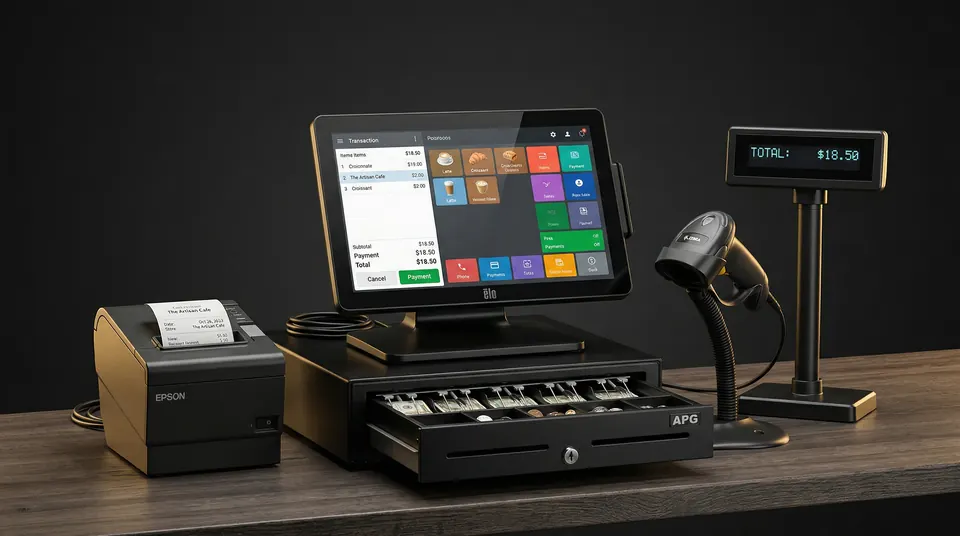
A stable POS workstation is the backbone of fast, accurate checkout and inventory movement.
Load-shedding-ready POS and offline resilience in 2026
You cannot afford an “all-or-nothing” checkout experience. Plan separately for internet and power interruptions: offline software can support local sales without internet, but terminals, servers and required peripherals still need electricity. Confirm suitable backup power and test which payment methods remain available during an outage.
TimeWorks supports offline mode, so local trading continues when internet is down. When connectivity returns, multi-location sync catches up with a single view of stock across locations. That reduces panic during peak checkout windows, because the tills do not become the bottleneck.

What to ask any POS provider before you commit
When you compare POS providers, do not only compare software features. Compare rollout and support. When the hardware, the data, and the workflow do not line up, your staff pays the price in rework.
Here is what we recommend you ask any provider, including when you are weighing up buying hardware against renting it:
- What happens at checkout when the connection is unstable? We want offline mode and automatic sync when the connection returns.
- How does inventory movement work across modules? Sales should update stock for food, treats, grooming supplies and health products the moment they are rung up.
- Can you run multi-location sync with a single stock view? If you have more than one branch, your POS should prevent mismatched counts.
- Do you offer local technicians who understand rollout? Local technicians who understand the rollout, the hardware, and the operational pressure.
- What is your rollout plan? A best-fit rollout plan should be phased, not disruptive.
We’ll recommend the best-fit software, terminals, peripherals, and rollout plan without overwhelming you with options you do not need. That approach keeps the implementation quieter for your team.
Retail POS patterns you can reuse: grooming, subscriptions and repeat buyers
Pet shop inventory control is not just “retail.” It blends retail POS workflows with service billing and repeat-purchase handling. That same pattern shows up in other retail environments where accuracy matters at the counter.
If you are also managing a grooming salon wing or subscription-style food refills, you can structure your data and checkout flow around those modules. TimeWorks includes grooming appointment billing and loyalty and subscription management, which helps when you want repeat customers to reorder without friction.
And if you sell health products next to food and toys, you need disciplined inventory movement so every line is counted the same way. The point is not complexity for its own sake. The point is inventory control that stays correct after busy trading days.
TimeWorks: a pet shop POS built for inventory control, not generic checkout
When you choose a pet shop POS, you want a system that already knows your operational demands. TimeWorks focuses on pet shop specific workflows and the stock discipline to match them.
Above, you can see the module focus clearly: species-specific product organisation, grooming appointment billing, high-SKU pet product stock management, barcode labels with one-click reprints, offline mode with multi-location sync, and loyalty and subscription management. That structure is what keeps inventory control aligned with how your shop runs.
We also built TimeWorks to be South Africa-friendly, including load shedding resilience and rand-based reporting, so your financial and inventory reporting stays grounded in local requirements.
Want to compare how TimeWorks approaches pet shop workflows? Start with the pet shop modules.
Renting or buying POS hardware, and how to avoid mismatches
Some shops start by renting POS hardware to move fast, others buy it to keep costs predictable. Either can work. The risk is when hardware choices do not match the workflow and data requirements of your inventory control.
Here is the clean way to reduce that risk in 2026:
- Match peripherals to your checkout pace. If your front desk needs quick grooming service billing, choose hardware that supports fast entry and minimal interruptions.
- Plan for offline mode. Hardware is only part of it. Your pet shop POS must continue trading and sync later.
- Keep the rollout plan aligned to your staff. We prefer a phased rollout that lets your team learn the quieter interface while still serving customers.
- Confirm multi-location sync early. If you run stock movement across locations, test the multi-location sync workflow before you go live.
If your budget planning also touches other retail formats, you can see how the broader approach applies. For example, TimeWorks content covers retail POS and hospitality POS, which share the same backbone idea: structured data, stable checkout, and clear back-office reconciliation.
Where pet shops get confused: full POS systems vs “simple” payments
Some teams look at quick payment tools first, then hope inventory control will come later. That is where operational pressure turns into daily rework. If you need inventory control, grooming billing and loyalty, you need a full POS approach, not a patchwork.
Two common comparisons you may hear in 2026 are:
- A card machine on its own vs a full POS system: A card machine takes payments quickly, but on its own it does not give you the structured inventory control and pet-specific modules you need when stock movement must stay accurate.
- TimeWorks vs GAAP: GAAP provides point-of-sale and inventory-management solutions, with a focus on restaurant and hospitality operations; it is not simply accounting software. Compare each provider's demonstrated support for your pet-shop catalogue, grooming billing, stock workflows, outage requirements and local support. See GAAP's published POS capabilities.
We are not saying one tool can never work. We are saying a pet shop that needs inventory control should choose software that is built for stock movement discipline from day one.
Buyer's guide FAQ
What should I look for in a pet shop POS in 2026?
Look for inventory control that updates from checkout immediately, plus structured product organisation for pet categories like species. Confirm offline operation for internet interruptions and separately size backup power for terminals, servers and necessary peripherals. Test the full outage workflow before relying on it.
Do I need offline mode for my pet shop POS?
Offline mode matters when your shop experiences internet interruptions: supported local sales can continue and sync when connectivity returns. It does not supply electricity. Power outages require suitable backup power, and card-payment availability depends on your payment provider and connectivity.
Can a pet shop POS handle grooming appointment billing and inventory control together?
Yes, when the system supports grooming appointment billing and links services to checkout flow. In a pet shop, grooming workflows should not be bolted on after the fact.
What’s the difference between a general retail POS and a pet shop POS?
A general retail POS often focuses on general categories, while pet shop POS should support species-specific product organisation, per-product reorder levels for a large food range, and grooming appointment billing. Inventory control needs those pet-specific workflows to stay accurate.
Is renting a POS worth it if we also need inventory control?
It can be worth it if the rental includes the right peripherals and the software still provides offline resilience and automated stock movement. The key is that your inventory control remains correct through downtime and reconnection. TimeWorks monthly rental, with hardware, software and support included, is from R995 per month excluding VAT; daily rental is contact for pricing.
How do TimeWorks inventory features help reduce stockouts for pet formulas?
When your POS connects sales to stock movement and supports automated reorder visibility, you reduce the chance of missing critical items. With tighter stock control, you are less likely to hit the stockouts that drive customers away.
Should we choose restaurant-style POS software or a pet-focused POS?
Choose pet-focused POS if inventory control needs include a large food range by pack size, grooming billing, and species-specific organisation. Restaurant POS can help with service billing, but pet shop workflows need structured inventory data aligned to your actual catalog.
Conclusion: choosing the right pet shop POS in 2026
Picking a pet shop POS with inventory control is choosing correctness at checkout, not just speed at the till. In 2026, you need offline resilience, structured inventory movement, and pet-specific modules like species organisation, grooming appointment billing, and loyalty and food subscriptions.
When we architect your point of sale around your actual workflows, the interface stays quieter, your data stays reliable, and your staff stops fighting ambiguity. That is the backbone you need for inventory control that holds up when the day gets busy.
Ready to Upgrade Your Pet Shop POS?
Talk to an Expert.
Talk to a TimeWorks specialist about grooming billing, loyalty and food subscriptions, and stock management. Rental and purchase options available with full setup and training.